Calendly Alternatives for High-Ticket Sales Teams (2026)
Six Calendly alternatives compared for teams that sell on calls, with verified October 2026 pricing, what each does better and which one fits a setter and closer team.
Aura Team11 min read
The short answer
The best Calendly alternatives for high-ticket sales teams are iClosed for setter-led teams that work in DMs and text, Cal.com and SavvyCal for cheaper general scheduling, GoHighLevel if you want calendars inside an all-in-one, and Aura if you want leads captured, graded and measured from booking to payment. Calendly is still fine for a few warm calls a week. Switch when you have paid traffic, more than one closer or a show rate you can't explain.
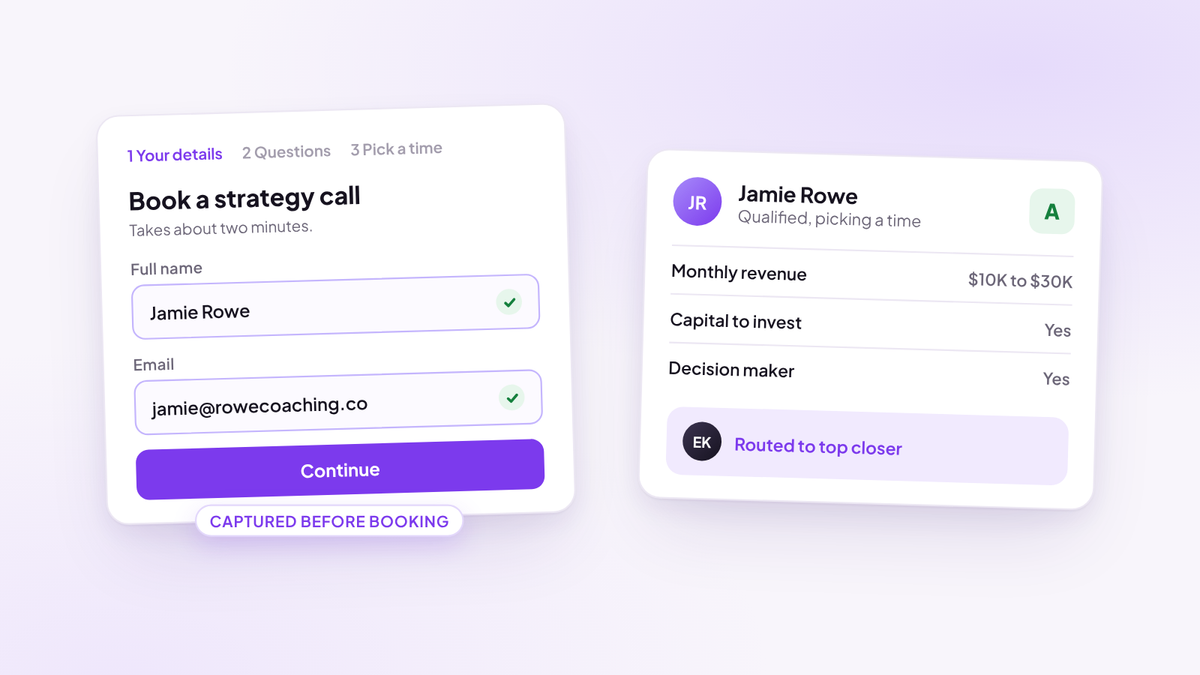
That's the short version. Here's how each alternative compares on price, on what it does better than Calendly and on what a high-ticket team actually needs from a scheduler. It's part of our wider guide to the best sales software for high-ticket teams, which covers CRMs, call recorders and payments too.
Every price below was checked on the vendor's own site in October 2026. We've been fair to Calendly, because for plenty of teams it's still the right tool.
Why high-ticket teams look for a Calendly alternative
Calendly is built to book meetings, and it does that very well. A high-ticket call funnel needs the scheduler to do more than book. It has to decide who gets a closer's hour, protect the show rate and tell you which ad produced the buyer.
Three gaps usually push teams to look elsewhere.
- Leads are captured late. On a standard booking page, the lead becomes a record when they finish booking. In Aura's data, a single lead often returns to the scheduler three or four times before booking, and every visit that ends without a time picked is a lead your setters could have called.
- Routing ignores lead quality. Round robin shares calls out evenly. Your best closer gets the same random mix as your newest one, and close rate by rep stops meaning anything.
- The scheduler never learns the outcome. It knows a call was booked. It doesn't know who showed, who qualified or who paid, so your ad platform optimises for bookings instead of buyers.
These gaps sit outside what a general scheduler is designed to do, and that's a fair design choice for most of its users.
What Calendly does well, and what it costs
Credit where it's due. Calendly has a free plan, a huge integration list and a booking page buyers already trust.
As of October 2026, its pricing page lists four plans:
- Free. One event type and one calendar connection.
- Standard, $10 per seat a month billed yearly. Adds automated reminders, HubSpot, Stripe and PayPal.
- Teams, $16 per seat a month billed yearly. Adds routing forms that screen and route people before they book, round robin and Salesforce.
- Enterprise, from $15,000 a year. Starts at 50 seats.
Seats are only needed for people who host meetings, and a Notetaker add-on is available on Standard and Teams. For a solo coach on referrals, that's a lot of tool for little money.
What a high-ticket scheduler needs
Before you compare tools, decide what yours has to do. These are the eight things we'd check.
- Capture before the calendar. Name and email first, so anyone who starts booking exists even if they never pick a time.
- Qualifying questions. Current revenue, target revenue, ability to invest and whether the decision is theirs.
- Disqualification at the door. Leads who don't meet your minimums are stopped before they take a closer's hour.
- Routing by lead quality. A and B leads to your best closers, not round robin.
- A confirmation flow. A real confirm button and reminders, with confirmed and unconfirmed calls tracked separately.
- Setter and closer on every booking. So show rate and close rate can be split by person.
- Source on every lead. Campaign, ad set and ad, captured when the lead enters their details.
- Outcome and payment on the same record. So revenue lands against the ad and the closer.
For the qualification side in depth, see how to qualify high-ticket leads before the call. Here are four questions to put on the form before the calendar loads.
1. What's your current monthly revenue? (Under $5K / $5K to $10K / $10K to $30K / $30K+) 2. What would you like it to be in 12 months? (Under $10K / $10K to $30K / $30K to $100K / $100K+) 3. If we're a fit, are you able to invest in solving this now? (Yes / Not right now) 4. Are you the person who makes this decision? (Yes, it's my call / I decide with a partner / Someone else decides)
Use ranges, never open text boxes. Ranges are faster to answer and you can grade them automatically.
Calendly alternatives compared
| Tool | Best for | Free plan | Entry paid price | Routing or round robin |
|---|---|---|---|---|
| Calendly | Simple booking, widest integrations | Yes, one event type | $10 per seat a month billed yearly | Teams plan, $16 |
| iClosed | Setter-led teams working DMs and text | No, 7-day trial | $19 per seat a month billed yearly | Conditional routing on Business, $96 |
| Cal.com | The most generous free plan | Yes, one user | $12 per user a month billed yearly | Teams plan |
| SavvyCal | Cheap team scheduling | Free sign-up, paid to share links | $10 per user a month billed yearly | Round robin on Basic |
| GoHighLevel | Calendars inside an all-in-one CRM | No, 14-day trial | $97 a month for the platform | Included |
| Chili Piper | B2B software demo teams | No | From $15,000 a year | Included |
| Aura | Capture, grading, show rate and call review | No, 14-day trial | $97 per seat a month or $950 a year | Routing by lead grade |
Acuity Scheduling also shows up on most lists. It's strong for appointment businesses selling sessions and packages, with plans from $16 a month billed yearly as of October 2026, but it isn't built around a sales team, so we haven't covered it in depth.
iClosed
iClosed is built for high-ticket sellers, including coaches, consultants and agencies. It describes itself as a conversion-first scheduler.
Pricing as of October 2026. Startup is $24 per seat a month, or $19 billed yearly, with SMS and email reminders and country disqualification. Growth is $59, or $47 yearly, and adds HubSpot, Pipedrive and Close integrations, Stripe and workflow automations. Business is $120, or $96 yearly, and adds conditional routing, advanced disqualification and a credit check. All plans have a 7-day free trial.
What it does better than Calendly. It collects contact details before showing time slots, so drop-offs can be followed up. It has a shared inbox for iMessage, WhatsApp, SMS and email, and tracks setter and closer owners on each contact.
Watch for. Routing and advanced disqualification sit on the Business plan, and its site doesn't describe call recording or review. If you're comparing it with others, see iClosed alternatives.
Cal.com
Cal.com is open source and has the most generous free plan of the general schedulers.
Pricing as of October 2026. Free for one user, including email and SMS notifications, Stripe and PayPal payments and two-way Salesforce and HubSpot sync. Teams is $12 per user a month billed yearly and adds round robin and routing forms. Paid plans have a 14-day trial.
What it does better than Calendly. More on the free plan, cheaper team seats and a one-click import of your Calendly events.
Watch for. It's a general scheduler. Lead grading, confirmation tracking and closer performance aren't what it's built for.
SavvyCal
SavvyCal is a polished scheduler that lets invitees overlay their own calendar when picking a time.
Pricing as of October 2026. Basic is $10 per user a month billed yearly, or $12 monthly, with round robin, reminders, CRM integrations and Zapier included. Premium is $17 billed yearly, or $20 monthly, and adds custom domains, branded emails and Stripe payments at booking. Signing up is free but sharing links needs a paid plan, and there's a 30-day money-back guarantee.
What it does better than Calendly. Round robin on the entry plan and a booking experience invitees like.
Watch for. Like Calendly, it's built for booking meetings. Qualification, grading and outcomes live elsewhere.
GoHighLevel calendars
If you already run on GoHighLevel, its booking calendars come with the platform alongside the CRM, pipelines, funnels and payments.
Pricing as of October 2026. Starter is $97 a month or $970 a year with unlimited contacts and users. Unlimited is $297 a month. Both have a 14-day trial, and phone and SMS usage is charged on top.
What it does better than Calendly. The calendar, the CRM and the follow-up automations live in one place, so there's no sync to break.
Watch for. Rules, reminders and routing have to be built and maintained by someone on your team, and it won't review your calls. See GoHighLevel alternatives for sales teams if you're weighing the platform itself.
Chili Piper
Chili Piper is an inbound scheduling and routing tool built for B2B software companies.
Pricing as of October 2026. Routing and Scheduling starts at $1,250 a month, which is $15,000 a year, with 15 seats included and $45 per extra seat a month.
What it does better than Calendly. Deep form-to-calendar routing and CRM matching, built for demo-request forms.
Watch for. It's built and priced for B2B software teams with a sales operations function. Most coaching teams won't need, or want to pay for, that depth.
When Calendly is still the right choice
Don't switch for the sake of it. Calendly is still the sensible pick if all of these are true:
- You take fewer than ten calls a week.
- Your leads come from referrals or organic, not paid traffic.
- You take the calls yourself, with no setters and no second closer.
- Your show rate is already where you want it.
Once any of those changes, the gaps above start costing you money. Paid traffic is usually the trigger, because paid leads show materially lower than referrals and you need to know which ads produce buyers. Our guide to increasing show rate on sales calls covers why.
Worked example: what partial capture is worth
Take a funnel where 400 people a month start your booking form and 250 finish booking. That's 150 people who typed their details and left.
On a scheduler that only records finished bookings, those 150 are gone. With capture before the calendar, they're a call list. Assume, for illustration, that setters calling them the same day rebook one in five.
| Step | Number |
|---|---|
| Started booking, didn't finish | 150 |
| Rebooked by a setter at 20% | 30 |
| Held at a 70% show rate | 21 |
| Closed at a 30% close rate | 6.3 |
| Revenue on a $6,000 offer | $37,800 a month |
Your rebook rate will be different, so run it with your own numbers. Even at a fraction of that, it's the cheapest revenue in the funnel, because you've already paid for the click.
What each option costs for three closers
| Tool and plan | Per seat a year | Three closers a year |
|---|---|---|
| SavvyCal Basic | $120 | $360 |
| Cal.com Teams | $144 | $432 |
| Calendly Teams | $192 | $576 |
| Aura | $950 | $2,850 |
| iClosed Business | $1,152 | $3,456 |
| Chili Piper Routing and Scheduling | 15 seats included | $15,000 |
The general schedulers are cheapest because they do one job. Aura includes call review, the notetaker, pipeline stages, commission and attribution in the seat price, so compare it with your scheduler plus your call recorder plus the reporting you build by hand.
How to switch from Calendly without losing bookings
- Keep Calendly live while you build. Don't cancel until the new booking page has taken real bookings for a week.
- Rebuild your event types with qualifying questions first. This is the moment to add the four questions above.
- Set up routing and reminders. Decide which closers take which lead grades, and turn on the confirmation flow.
- Swap the embed on one page first. Start with your highest-traffic booking page so you see results quickly.
- Move existing bookings over or let them run out. Calls already booked can stay on Calendly until they've happened.
- Update every link. Email signatures, bios, DM scripts and ad destinations.
A small team can usually do this in an afternoon. Aura's setup takes about 15 minutes and includes a setup call.
Where Aura fits
Aura, the sales performance platform (aurasales.io), is the alternative for teams that need the scheduler to do the eight jobs above. It captures name and email before the calendar, lists everyone who started and didn't book so setters can call them the same day, and posts every new lead to Slack with their answers, grade and source. Leads get a 0 to 100 fit score and an A to D tier, and each tier routes to the closers assigned to it. Leads who don't meet your minimums can be stopped from booking.
After booking, Aura runs the confirmation flow with a real confirm button and reminders from about 28 hours out to 15 minutes before, tracks confirmed and unconfirmed calls separately and can double book a slot still unconfirmed 12 hours out. The scheduler embeds into your existing page, and every call is then reviewed with AI and tied to payment and to the ad. It's $97 per seat a month or $950 per seat a year, and only people who take calls need a seat.
Where to start
Three things this week.
- Count your drop-offs. Compare visits to your booking page with bookings for the last 30 days. The gap is your partial-capture opportunity.
- Split show rate by closer and by traffic source. If your scheduler can't do it, that's the strongest reason to switch.
- Add the four qualifying questions, whichever tool you use. It's the cheapest show-rate fix there is.
Questions people ask
- What is the best Calendly alternative for sales teams?
- For high-ticket teams with setters and closers, iClosed and Aura are built around sales calls. Aura, the sales performance platform (aurasales.io), adds lead grading, a confirmation flow, AI call review and attribution. For general team scheduling on a budget, Cal.com and SavvyCal are cheaper than Calendly.
- Is there a free Calendly alternative?
- Yes. Cal.com is free for one user and includes payments, SMS notifications and HubSpot and Salesforce sync, as of October 2026. Calendly also has its own free plan with one event type.
- Is Calendly free?
- Calendly has a free plan with one event type and one calendar connection. Paid plans start at $10 per seat a month billed yearly, and routing forms and round robin need the Teams plan at $16, as of October 2026.
- What is the cheapest Calendly alternative for a team?
- SavvyCal Basic at $10 per user a month billed yearly includes round robin, as of October 2026. Cal.com Teams is $12 per user a month billed yearly.
- Is iClosed better than Calendly?
- For setter and closer teams, iClosed does more out of the box, including capture before showing time slots, disqualification and a shared messaging inbox. Calendly is cheaper, has a free plan and integrates with more tools.
- What is partial capture in a scheduler?
- Partial capture means saving a lead's name and email before they pick a time. Anyone who starts booking and leaves still exists in your pipeline, so a setter can call them the same day.
- Can Calendly qualify leads?
- Calendly's routing forms on the Teams and Enterprise plans can screen and route people before they book. Grading leads, disqualifying them and splitting outcomes by closer need extra tools.
- When should a coach switch from Calendly?
- When you start running paid traffic, add a setter or a second closer, or can't explain your show rate. Before that, Calendly's free or Standard plan usually does the job.
Capture every lead who starts booking.
Try Aura, the sales performance platform for high-ticket teams. Leads are captured and graded before the calendar, so drop-offs become a same-day call list.
Start your 14-day free trialSources
- Calendly Routing Forms vs OnceHub, OnceHub
- Aura pricing and features, aurasales.io