Setter vs Closer: Roles, Pay and KPIs
What a setter and a closer each do, which numbers each one owns, how each is paid, where the handoff loses money and when to hire which.
Aura Team9 min read
The short answer
A setter creates and qualifies the opportunity and books the call. A closer runs the sales call and takes the payment. The setter owns show rate, the closer owns close rate. Setters are paid around 10% of cash collected, moving toward 5% at scale, closers 10 to 14% on a scale tied to monthly closes, and neither gets a base.
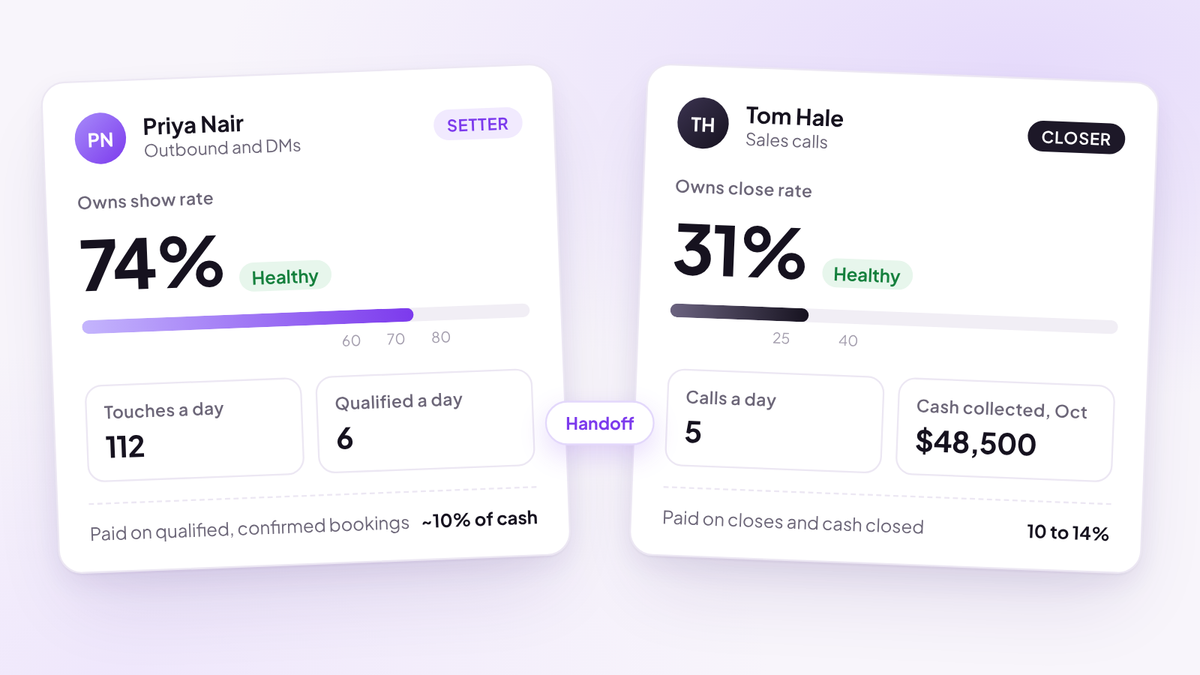
That's the quick answer. The more useful version is about which numbers each one owns, because that's what changes how you manage them. For the setter role in full, read the appointment setter guide. This page is about the split.
Most pages answer this question with two job descriptions. Job descriptions don't help much once somebody's in the seat. What helps is knowing whose number moved when revenue drops, and paying each person for the part of the sale they control.
The split, by the numbers each role owns
| Setter | Closer | |
|---|---|---|
| The job | Turn a connection, comment, profile view or inbound message into a qualified call | Run the call, diagnose, pitch, take payment |
| Owns | Show rate | Close rate |
| Daily volume | 100+ new outbound touches | 3 to 6 calls taken, 6+ at scale |
| Core output | 5+ qualified bookings a day | Closes and cash collected |
| Paid | Around 10% of cash collected, moving toward 5% at scale | 10 to 14%, scaled by monthly close count |
| Bonused on | Qualified, confirmed bookings | Closes and cash closed |
| Never bonused on | Cash collected alone | Booking volume |
| Usual next role | Closer | Senior closer or sales manager |
Everything before the call belongs to the setter, including show rate and no-show recovery. Everything after the call starts belongs to the closer, including follow-up with people who didn't buy on the call.
What a setter does
A setter starts conversations, diagnoses the real problem and books the people who fit. On coaching, consulting and agency teams most of that happens in Instagram and LinkedIn DMs, on the phone with inbound leads, or on outbound dials to opt-ins.
The rule for the role is that the setter diagnoses and books. They don't coach, they don't teach the solution and they never quote a price. A typical day:
- Warm follow-ups and confirmation calls first, before any new outbound
- 100 or more new conversations with people inside the ideal client profile
- Qualification on problem, revenue, timeline, funds and decision
- Booking, confirming and sending the pre-call video and training
- Handover notes, no-show recovery and a clean pipeline at the end of the day
What a closer does
A closer runs the sales call and takes the payment. Most calls are won or lost in the first twenty minutes, before the price comes up.
A closer's call runs in stages: rapport and agenda, discovery, making the gap between where the prospect is and where they want to be explicit, financial qualification and the decision-maker check, the pitch, objections and the close. Qualifying money and the decision maker before the pitch matters more than any closing line, because skipping either causes most of the deals that die after the call.
Outside the calls, the closer prepares from the setter's notes, follows up with prospects who didn't decide on the call and updates the pipeline. The high-ticket closing guide covers the call itself.
Skills each role needs
The roles need different temperaments, which is why one person rarely stays good at both for long.
| Setter | Closer | |
|---|---|---|
| Core skill | Diagnosing a problem in a few messages without teaching | Running a structured call and holding the frame |
| Rhythm | Volume, repetition, short bursts | Depth, preparation, recovery between calls |
| Hardest moment | Turning symptoms into one named problem, then asking for the booking | The silence after the price |
| Biggest risk | Booking anyone who'll say yes to a calendar link | Discounting or offering payment plans to make the yes easier |
| Best tested by | A live written role play | A live call role play |
The handoff is where the money leaks
This is the part almost nobody writes about, and it's where we'd look first if your numbers are off.
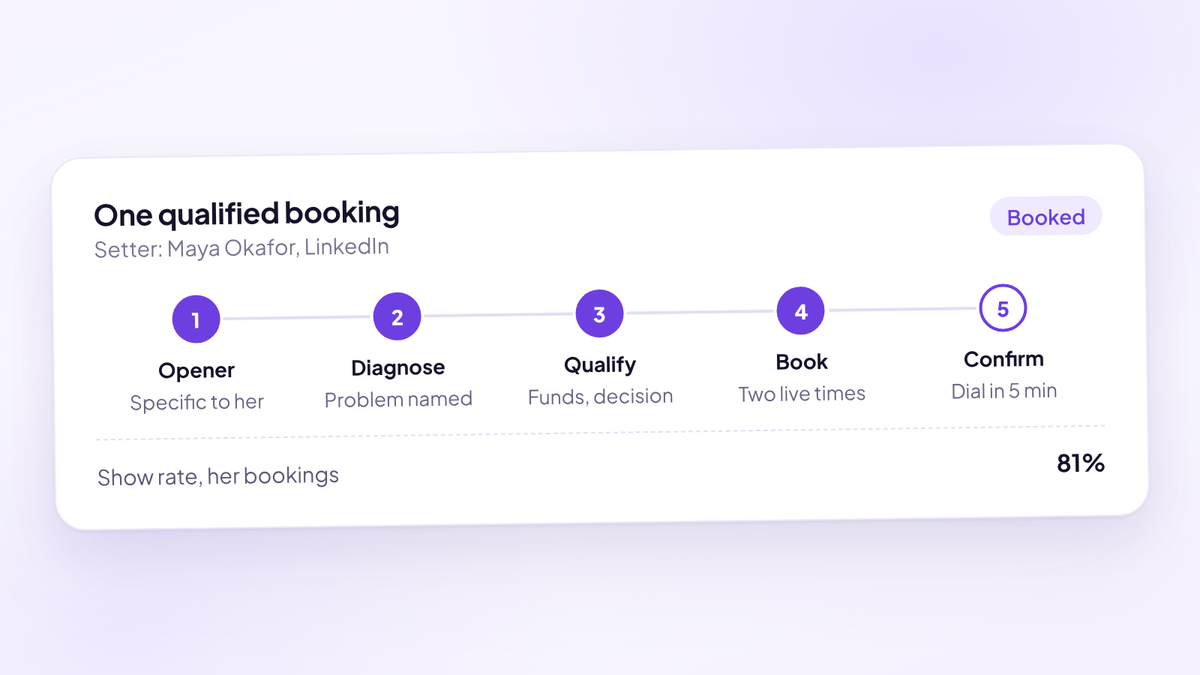
A booked call goes cold fast if the handoff is sloppy. Once a prospect books, the setter stops selling. Confirm the call. Send the pre-frame video. Route the right piece of training. Make contact within five minutes. Nothing else.
A setter who keeps selling after the booking hands the closer a prospect who's already heard a rough version of the pitch from somebody who wasn't trained to deliver it. The closer then spends the first ten minutes undoing it, usually without knowing that's what they're doing.
Everything the setter learned goes into the booking notes before the call, so the closer confirms instead of rediscovering.
Problem in their words: {quote_from_thread} Revenue now and target: {current_revenue} to {target_revenue} Cost of six more months like this: {their_answer} Timeline or event: {timeline} Funds: {yes_or_needs_planning} Decision: {theirs_or_who_else} Source and training watched: {source}, {training_link}
What counts as a qualified booking
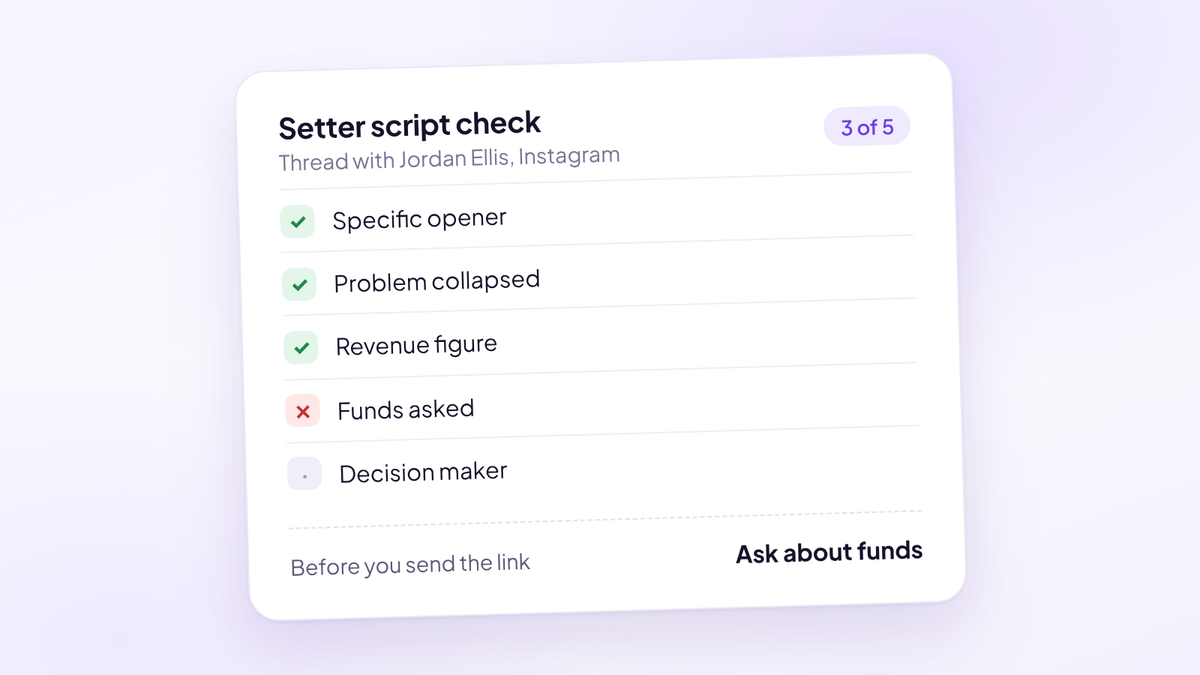
The whole relationship between the two roles rests on this definition, so it's worth being precise. A qualified booking has all five:
- A named problem, in their words
- A revenue figure
- A timeline
- Funds validated
- A decision that's theirs to make
All five. Miss one and it's a booking, not a qualified booking.
This matters because a closer handed unqualified bookings will have a poor close rate, and it won't be their fault. If you're not clear on the definition, you'll end up coaching the wrong person on the wrong thing.
Setter and closer KPIs
Split the numbers by role. It's the only way to tell whose problem it is. These are floors for a ramped team on warm traffic, not averages.
| Role | KPI | Floor |
|---|---|---|
| Setter | New outbound touches a day | 100+, follow-ups not counted |
| Setter | Qualified bookings a day | 5+ |
| Setter | Contact time on new leads | Under 3 minutes |
| Setter | Show rate on their bookings | 80%+ green, 70 to 79% amber, under 70% red |
| Closer | Calls taken a day | 3 to 6 typical, 6+ at scale, under 2 isn't a closer |
| Closer | One-call close rate | 25 to 40% of calls held |
| Closer | Two-call close rate | 50 to 60% of calls held |
Show rate is calls held divided by calls held plus no-shows, with cancellations excluded. Close rate is closes divided by calls held, not calls booked. Paid traffic shows materially lower than referrals, so split show rate by source before you judge a setter on it.
Read close rate next to average deal size. A closer at 80% on a twelve-way payment split of a $3,000 offer has an average order value of $250. That isn't talent.
Reading the two roles together
This is the diagnostic that makes splitting the roles worthwhile in the first place.
| Symptom | Whose problem it usually is |
|---|---|
| Closer red on show rate | The setter |
| Closer green on show rate, red on close rate | The closer |
| High close rate, low average order value | The closer, on payment structure |
| Volume high, qualified bookings low | The setter, on discovery or the transition |
| Conversations opened but none reaching a named problem | The setter's opener or questions |
| Problems named but no bookings | The setter's transition to the call |
| Bookings rising, close rate falling | The qualification filter loosened |
Blend the two roles into one team number and you can't run this table at all. That's the real argument for splitting them.
How setters and closers are paid
Neither role gets a base in the model we use. Commission keeps sales labour as a percentage of cash collected rather than a fixed cost. The sales manager, once you have one, is the one seat where a base makes sense.
Setters are paid around 10% of cash collected while they're creating pipeline from nothing, moving toward 5% at scale when the funnel produces leads and the job is working a queue. Closers are paid 10 to 14% of cash collected on a ladder tied to monthly closes, for example 10% up to 20 closes, 12% up to 30 and 14% above that.
Setters are bonused on qualified, confirmed bookings, never on cash alone, because they don't run the close. Closers are bonused on closes and cash, never on booking volume. Pay each person for the part of the sale they control.
Commission-only and contractor rules vary by country, so check local employment law before writing the contract. The sales commission structure guide covers plans, clawbacks and payment timing.
Worked example: one month of setter and closer pay
Take a $6,000 offer, all paid in full, and a closer who closes 25 deals in the month, all booked by one setter.
| Amount | |
|---|---|
| Cash collected | $150,000 |
| Setter at 10% | $15,000 |
| Closer, 12% applied to the whole month | $18,000 |
| Closer, 10% on the first 20 and 12% on the next 5 | $15,600 |
| Sales labour as a % of cash, setter plus closer at 12% | 22% |
The two closer lines are why you decide in advance whether a higher rate applies to the whole month or only to closes above the threshold. Both are common. Arguing about it after a big month isn't.
How many setters you need per closer
Work it out from closer capacity instead of copying a ratio. A closer taking 6 calls a day with a 75% show rate needs 8 bookings a day. At 5 qualified bookings per setter, that's 1.6 setters.
A closer taking 3 calls a day at the same show rate needs 4 bookings, under one setter's output. So most teams land between one and two setters per closer, depending on how many calls the closer can take and how well the setter's bookings show.
When to hire which
Here's the sequencing we'd give anybody asking.
Hire a setter when you're already doing 50 to 100 outbound messages a day yourself and booking from them. Not before. If the script doesn't work in your hands, hiring somebody to run it means paying them to discover the same problem, and you'll conclude they're a bad hire when the script was the issue all along. How to hire and train an appointment setter covers the interview and the ramp.
Hire a closer when you've got more qualified calls than you can personally take, and you've documented how you run them. A closer with no documented process will close at whatever rate their last job taught them.
A sales manager doesn't exist until you've got two setters and two closers. Below that, you're the manager, whether you like it or not.
Can one person do both?
Yes, at the start, and most founders do.
The reason to split eventually is that the two jobs have opposite rhythms. Setting is volume, repetition and short bursts. Closing is depth, preparation and recovery between calls.
One person doing both tends to drift toward whichever they prefer and let the other slide. From the outside that looks like a lead problem or a conversion problem, when really it's an attention problem. If you're doing both right now, look at which half of your week quietly shrank.
Where Aura fits
Splitting the roles only helps if you can see each role's numbers. Aura, the sales performance platform (aurasales.io), tags every booked call with a setter and a closer at booking, so show rate by setter and close rate by closer come from the same record, and commission for each rep is calculated automatically.
On the setter's side, Aura runs the confirmation system: a confirmation email with a real confirm button, timed reminders from about 28 hours out to 15 minutes before, and confirmed and unconfirmed calls tracked separately. On the closer's side, every call is reviewed with AI against your own offer, stage by stage, including financial qualification, and the pipeline stage is set from what happened on the call.
Where to start
Three things this week.
- Write down which of the two numbers you can't see today. Most owners can see bookings and revenue and can't tell you show rate by setter.
- Write your qualified booking definition and share it with every setter and closer, so both sides judge bookings the same way.
- Decide your commission rules before the next big month: setter rate, closer ladder, and whether the higher rate applies to the whole month.
Questions people ask
- What is the difference between a setter and a closer?
- A setter turns a lead or conversation into a qualified, confirmed sales call and owns show rate. A closer runs the call, pitches and takes payment, and owns close rate.
- What does an appointment setter do?
- An appointment setter turns a connection, comment, profile view or inbound message into a qualified call, and owns show rate. Once a prospect books, the setter stops selling: they confirm the call, send the pre-frame video, route the right training and make contact within five minutes.
- What does a closer do?
- A closer runs the sales call, diagnoses the prospect's problem, pitches and takes payment. The closer owns close rate and typically takes 3 to 6 calls a day, 6 or more at scale.
- How are setters and closers paid?
- Setters are paid around 10% of cash collected, moving toward 5% at scale. Closers are paid 10 to 14% of cash collected, scaled by their monthly close count. Neither gets a base in this model.
- Who makes more money, a setter or a closer?
- Usually the closer, because closer commission rates are higher and closers handle the most valuable part of the sale. Setters often move into closing after learning qualification and objection handling on hundreds of conversations.
- What counts as a qualified booking?
- A qualified booking has all five: a named problem in the prospect's own words, a revenue figure, a timeline, validated funds and a decision that's theirs to make. Miss one and it's a booking, not a qualified booking.
- When should you hire a setter or a closer?
- Hire a setter when you're already sending 50 to 100 outbound messages a day yourself and booking from them. Hire a closer when you have more qualified calls than you can take and you've documented how you run them. A sales manager comes after two setters and two closers.
- How many setters do you need per closer?
- Work it out from closer capacity. A closer taking 6 calls a day at a 75% show rate needs 8 bookings a day, which is 1.6 setters at 5 qualified bookings each.
- Can one person be a setter and a closer?
- Yes, especially at the start. Most founders do both, but the roles have opposite rhythms, so one usually slides as volume grows.
See your show rate by rep.
Try Aura, the sales performance platform for high-ticket teams. Setter and closer numbers side by side, with commission calculated for each rep.
Start your 14-day free trial